
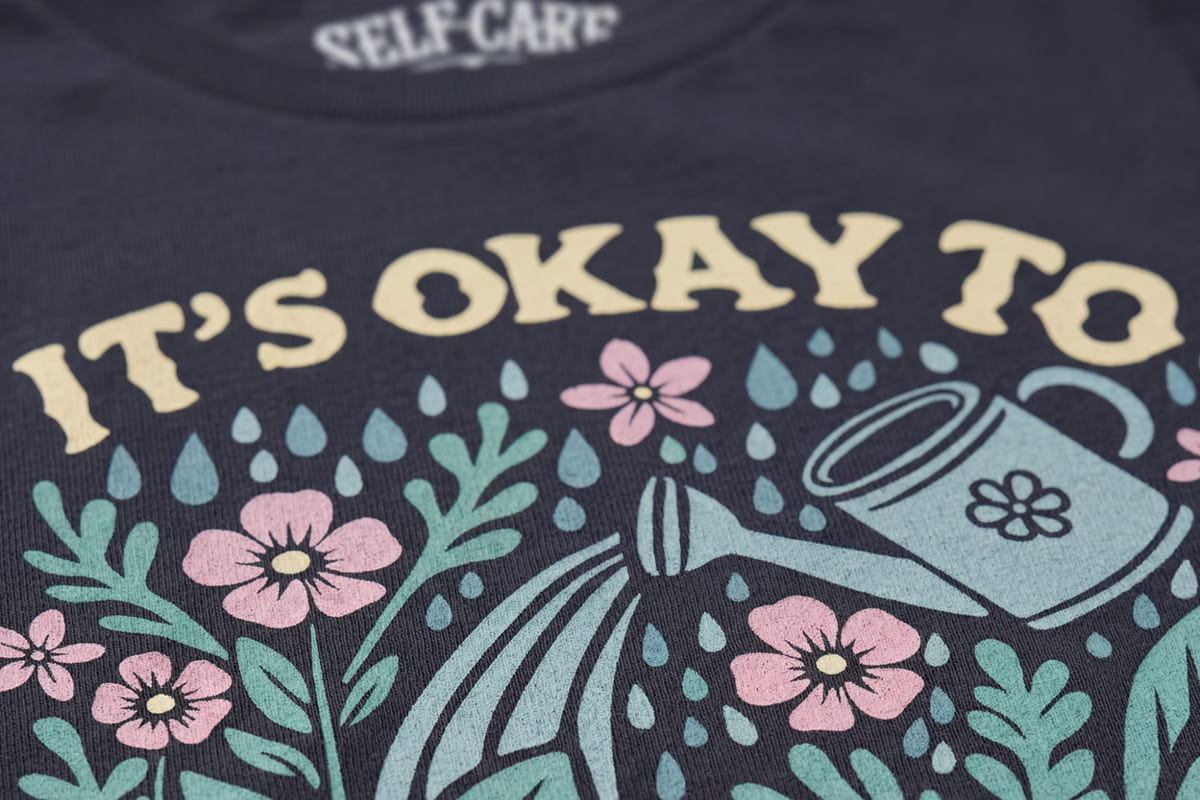
Living with ADHD, designer Alyssa Ostroff, founder of Self-Care Shirts, started drawing comforting messages on her own t-shirts to calm her anxiety. She explains why this simple trick physically helps our brain feel better.
I started drawing affirmations during the hardest season of my life.
Not to sell them. Not because I had a business plan. Because I needed something to wear on the days I didn't believe the thing yet, something that would say it out loud, on my body, in my own handwriting, even when my brain was too exhausted to keep repeating it internally.
I drew "You Are Enough" on a Tuesday when I genuinely wasn't sure that was true. I wore it anyway. And something happened that I couldn't explain at the time but have since learned has a name, a body of research, and measurable neurological underpinnings.
It helped.
Not because the shirt fixed anything. Because wearing a word, by physically carrying a message against your skin and displaying it to the world and to yourself, does something to how you think and feel that simply reading the same message on a screen does not.
The field that studies this is called embodied cognition. And what it suggests about mental health, art, and the way we process the things we need to hear is more interesting than most people realize.
The Science of Wearing What You Think
In 2012, researchers Adam and Galinsky at Northwestern University published a study in the Journal of Experimental Social Psychology coining the term "enclothed cognition": the systematic influence that clothes have on the wearer's psychological processes.
Their landmark experiment involved lab coats. Participants who wore a coat described as a "doctor's coat" performed significantly better on attention tasks than those who wore the same coat described as a "painter's coat" (or who simply saw the coat lying on a table). The physical act of wearing the garment, combined with the symbolic meaning associated with it, produced measurable changes in cognitive performance.
The key mechanism is dual: clothing works on us both physically (through the sensation of wearing it) and symbolically (through the meaning we and others assign to it). Neither alone produces the full effect. Both together create something the researchers called "embodied cognition", the idea that our physical experience of our bodies is not separate from how we think, but is deeply intertwined with it.
Subsequent research has expanded this framework considerably. Studies have found that wearing formal clothing increases abstract thinking. Athletic wear increases physical performance. And, most relevant to mental health, clothing associated with personal values and identity increases feelings of psychological safety, groundedness, and self-efficacy.
Put more simply: what we wear changes who we think we are, even temporarily. And who we think we are changes what we're capable of.
Why this matters for mental health, especially for neurodivergent brains
For neurotypical people, internal reminders and self-talk can serve as reasonably reliable regulation tools. For brains wired differently — ADHD, autism, anxiety disorders, trauma responses — internal regulation is significantly harder.
I was diagnosed with AUDHD (combined ADHD and autism) as an adult, after decades of not understanding why my emotional regulation worked so differently from other people's. One of the hallmarks of ADHD in particular is difficulty with what researchers call "working memory" — the ability to hold information in mind and use it to guide behavior. People with ADHD often know, intellectually, the thing they need to remember. They simply cannot reliably access it when they need it most.
This is why external cues are so powerful for neurodivergent people, and why wearable affirmations function differently for this population than for the general public.
A reminder written on a sticky note can be ignored. A reminder worn on your body cannot. It exists in your peripheral vision, in the sensation of the fabric, in the moments when someone reads it and responds. It is, in the language of behavioral psychology, an environmental modification, a change to the external context that compensates for the difficulty of internal regulation.
Research on ADHD management consistently finds that external structure and cues outperform internal willpower as regulatory tools. Wearable affirmations are, in their own informal way, an application of this principle. They externalize the reminder. They put the message somewhere the brain doesn't have to work to access.
For someone whose nervous system is already running at capacity — managing sensory input, executive function demands, emotional dysregulation — having the affirmation literally on your body reduces the cognitive load of remembering to remember.
Art as emotional infrastructure
There is a reason the affirmations I draw resonate differently than the same words printed in a corporate font by a wellness brand.
Art carries information that words alone do not. The line quality, the composition, the specific visual decisions made by a human hand in a specific emotional moment: these transmit something. Viewers and wearers respond to handmade art differently than to manufactured graphics, even when they cannot articulate why. This is not sentiment. It is measurable.
Research in neuroaesthetics, the study of how the brain processes art, has found that handmade objects activate different neural pathways than machine-produced ones. We process them with more of ourselves. We assign them more meaning. We feel more connected to the person who made them.
When I draw a phrase I personally needed to hear, that emotional context is embedded in the work ; in the specific way I lettered it, the imperfections that survived, the choices I made about weight and space. And when someone wears that drawing, they are not just wearing a message. They are wearing evidence that another human being felt what they feel and survived it well enough to make something.
That is not a small thing. In mental health terms, that is the experience of being seen, one of the most consistently identified factors in psychological healing across therapeutic modalities.
The public dimension: Stigma and visibility
Wearing a mental health message in public is an act with consequences that extend beyond the wearer.
Mental health stigma operates primarily through silence. The less visible mental health struggles are, the easier they are to dismiss, minimize, or ignore. Every time someone wears "It's Okay to Not Be Okay" to the grocery store, they are, whether they intend to or not, making a small, visible argument against that silence.
Research on stigma reduction consistently identifies normalization as one of the most effective interventions. Repeated, casual exposure to mental health language, not in crisis contexts but in everyday contexts, reduces the perceived abnormality of mental health struggles over time. It shifts the cultural baseline of what is mentionable.
Wearable mental health messaging participates in this normalization passively, continuously, and at scale. One person wearing a shirt makes a statement in every interaction they have that day. Over time, across thousands of people, this accumulates into something that functions like a public health intervention: distributed, decentralized, and powered by individual choice.
What this mean in practice
If you are someone who struggles with internal regulation, whether through ADHD, anxiety, depression, trauma, or simply the ordinary difficulty of being human, there is genuine science behind the idea that your external environment affects your internal state.
You do not have to rely entirely on internal willpower to feel differently. You can modify your environment. You can wear the thing. You can put the reminder somewhere your body can access it even when your brain cannot.
And if you make or buy art that carries meaning, art made by a human hand, embedded with the emotional context of its creation, you are accessing something that machine-produced content cannot replicate. You are wearing evidence that you are not alone in this.
That evidence matters. Research says so. And so does every person who has ever looked down at their shirt on a hard day and felt, just slightly, less alone.
Bibliography
Adam, H., & Galinsky, A. D. (2012). Enclothed cognition. Journal of Experimental Social Psychology, 48(4), 918–925. https://doi.org/10.1016/j.jesp.2012.02.008